

Here’s a number that should sting: the average service-based SME loses $87,000 annually to manual task execution—lead follow-up delays, misrouted inquiries, redundant data entry, and the compounding interest of decision fatigue. That’s not a staffing problem. That’s a systems problem.
And yet, the default response is to hire.
Psychologists call this status quo bias. It is a cognitive shortcut that tells your brain the familiar solution (adding headcount) is safer than the unfamiliar one (deploying autonomous agents).
However, it’s just more expensive and slower, and it scales linearly when your competition is scaling exponentially.
In 2026, the businesses winning on margin aren’t the ones with the most people. They’re the ones with the most intelligent systems running with the fewest.
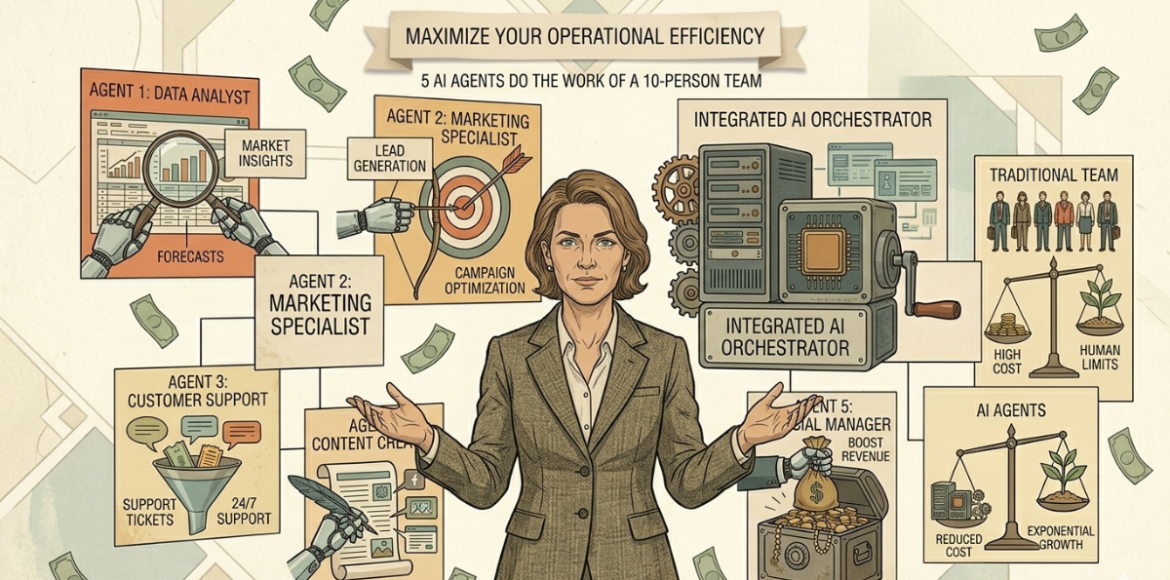
The 5 AI agents below are deployable, operational, and if configured correctly, they can replace the output of a 10-person operations team by next quarter. Let’s jump right into it.
Here’s what a lean, agent-powered team actually looks like
Before we get into the agents themselves, let me be direct about what “doing the work of 10 people” actually means in practice.
It doesn’t mean firing everyone. It means redirecting your human capital toward work that requires genuine judgment like strategy, relationship-building, creative problem-solving while agents handle the high-volume, rule-based, and time-sensitive tasks that are currently eating your best people alive.
I’ve watched a plumbing business in San Diego hemorrhage roughly 40% of its inbound leads because their follow-up process ran on one operations coordinator’s memory and a sticky note system. There’s wasn’t any automation and CRM qualification. Once we installed an inbound qualification agent, their lead-to-booking rate improved by 60% in six weeks without a single additional hire.
That’s the arbitrage this technology offers. Let’s walk through the five agents that make it real.
Agent 1: The inbound qualifier
The Inbound Qualifier is the first agent most of our clients deploy, and the ROI is immediate enough to trigger what behavioral economists call the endowment effect. Once businesses experience having it, they find it psychologically difficult to imagine operating without it.
Here’s what it does: the moment a lead submits a form, books a discovery call, or sends an inquiry email, the Inbound Qualifier fires. It cross-references the lead’s data against your Ideal Customer Profile (ICP) criteria, asks clarifying questions via automated follow-up, scores the lead on a weighted rubric you define, and routes them either to your calendar for a live consultation or to a nurture sequence if they don’t meet the threshold.
Response time goes from hours to seconds. The agent doesn’t sleep. It doesn’t prioritize quick leads over complex ones based on personal bias. It applies your criteria consistently.
What it replaces
A full-time sales development rep (SDR), plus the cognitive load your best closer currently wastes on dead-end conversations.
The power stack for this agent
Make.com for workflow orchestration, an LLM layer (Claude Sonnet or GPT-4o) for contextual lead assessment, and your CRM (HubSpot, Salesforce) as the data destination.
The ROI math
A mid-level SDR in a U.S. market costs $65,000–$85,000 annually with benefits. An Inbound Qualifier agent costs, depending on volume, roughly $300–$800 per month to run. The agent doesn’t call in sick during your biggest trade show of the year.
Stop: Is Your Business Actually Ready for an AI Employee?
Before you buy another subscription, take our 60-Second Agent Audit below. We’ll tell you exactly which part of your workflow is ‘Agent-Ready’ and which part still needs a human touch.
Stop: Is Your Business Actually Ready for an AI Employee?
Before you buy another subscription, take our 60-Second Agent Audit.
Agent 2: The research analyst
Most important intellectual habit a businessperson could develop was going to bed a little smarter than you woke up. Most founders want that. None of them have the time for it. The Research Analyst agent is what buys that time back.
This agent monitors your designated intelligence sources, such as competitor websites, industry publications, LinkedIn activity from target accounts, Google News for relevant keywords, and delivers a synthesized briefing to your inbox or Slack channel every morning.

But that's the baseline version. The advanced deployment is the one worth building: a Research Analyst that runs pre-call intelligence on every prospect your sales team is about to meet.
Forty-five minutes before a discovery call, the agent pulls the prospect's recent LinkedIn activity, their company's latest press releases, any shared connections, and any relevant trigger events (funding rounds, new hires, product launches), then drafts a context brief your rep reads in four minutes.
I've seen this agent alone increase discovery call close rates by 20–35% for our clients, as they walked in informed instead of improvising.
What it replaces
A junior analyst, a research assistant, and about four hours of your founder's week.
The power stack for this agent
Perplexity API for live web research, a structured output layer for formatting, and Slack or email for delivery.
The ROI math
A junior research analyst costs $45,000–$55,000 annually. A freelance research assistant runs $25–$60 per hour. This agent runs at roughly $100–$300 per month. More importantly if your average deal size is $10,000 and this agent lifts your close rate by even 15%, one additional closed deal per quarter pays for the agent for the next three years.
Agent 3: The operations coordinator
The Operations Coordinator agent monitors your project management system (Asana, ClickUp, Monday.com), identifies tasks that are overdue, stalled, or approaching a deadline without the required predecessor being complete, and fires the appropriate nudge to the right person, in the right channel, at the right time.
It also handles calendar coordination: when a client needs to reschedule, the agent manages the back-and-forth, finds alignment across multiple calendars, and confirms the new slot without a human touching the thread.
What separates the high-performing deployments from the mediocre ones is the System Operating Procedure (SOP) behind the agent. An agent is only as good as the logic you give it. If you can't write a manual for the coordination process, the agent can't execute it, which coincidentally, is also why most businesses' coordination processes are broken.
Take our friend Bruce Wayne, who runs a mid-size consulting firm and he is, by all empirical measures, the most expensive person in the building to have manually coordinating project deliverables, scheduling client check-ins, and chasing down team members for status updates. His hourly rate is north of $400. The cognitive overhead of coordination costs him three hours a day. Do that math.
What it replaces
A project coordinator, a scheduling assistant, and the 47 times per week you ask yourself "did that actually get done?"
The power stack for this agent
Zapier or Make.com as the orchestration layer, Google Calendar API for scheduling logic, and Slack for human-in-the-loop escalations on edge cases.
The ROI math
A dedicated project coordinator costs $50,000–$65,000 per year. But that's the obvious number. The less obvious one: if your founder or senior operator is spending three hours a day on coordination at a $300–$400 effective hourly rate, that's $225,000–$300,000 in misallocated labor annually. The agent costs $200–$500 per month. Bruce Wayne should not be chasing task updates. He should be closing deals.
Your Competitors Are Hiring Humans.
You Should Be Hiring Algorithms.
In 2026, scaling your headcount is a liability; scaling your output is the goal. If you’re still paying a human $50k a year to move data between spreadsheets or 'follow up' with cold leads, you aren't running a business—you're running a charity for inefficiency.
We build 'Digital Employees' that don’t sleep, don’t take sick days, and execute your SOPs with 100% precision. We deploy custom Agent Stacks that reclaim 20+ hours of founder time per week.
*Strictly for SMEs doing $500k+ in annual revenue.
Agent 4: The client success agent
The single most underrated revenue lever in a service business isn't new acquisition. It's retention. The math is elementary: a 5% improvement in retention produces a 25–95% improvement in profit, depending on your margin structure. Yet most SMEs run their client success function reactively. They wait for a client to express dissatisfaction before responding.
That's not client success. That's client rescue.
The Client Success Agent shifts the function from reactive to proactive. It monitors a set of behavioral signals you define (email response time dropping, project milestone feedback going quiet, usage metrics declining in a SaaS context, invoice payment delays), and interprets them as early warning indicators of churn risk.
When the signal crosses your defined threshold, the agent triggers a personalized check-in sequence from your account management team, flags the account in your CRM, and prepares a briefing with context on the account's history.
No client should feel neglected while your team is focused elsewhere. The agent makes sure they don't.

What it replaces
A junior account manager, a churn prediction analyst, and the reactive fire-drills that consume your senior team.
The power stack for this agent
A webhook-driven trigger system monitoring your CRM data, a conditional logic layer scoring churn risk, and a personalized outreach draft delivered to your human account manager for review before sending. The human is still in the loop but they're acting on intelligence, not instinct.
The ROI math
A junior account manager runs $50,000–$70,000 annually. But the real cost of not having this agent isn't a salary; it's a client. If your average client is worth $24,000 per year in recurring revenue and you lose two clients this quarter that a proactive check-in would have retained, that's $48,000 in annualized revenue lost to a problem that costs $150–$400 per month to solve.
Agent 5: The content and outreach engine
The Content and Outreach Engine doesn't write generic blog posts and spray them across your social channels. That's not automation; that's noise with extra steps. What it does is monitor your business's recent work, pull in the signal (a completed case study, a closed deal, a question a prospect asked three times this week, a new industry report), and generate first-draft assets calibrated to your brand voice and target audience.
The human's job is editorial direction and final approval. The agent's job is to eliminate the blank-page problem and compress the production timeline.
The outreach component is equally specific: when a prospect opens your proposal three times in 48 hours without responding (a trigger event that most CRMs track and most founders ignore), the agent generates a contextually relevant follow-up. This is not a generic just checking in email. A follow-up that references something specific to their industry, their company's recent activity, or the proposal section they presumably spent the most time on.
The behavioral principle at work here is timing asymmetry. The value of outreach degrades by roughly 10× for every 24 hours you wait after a trigger event. Automation eliminates the delay.
What it replaces
A content strategist, a copywriter, and the three-week content calendar that never quite gets published on time.
The power stack for this agent
Clay for outreach personalization at scale, an LLM layer for content drafting calibrated to your brand voice, and your CRM as the trigger source.
The ROI math
A mid-level content strategist costs $60,000–$80,000 annually. A freelance copywriter bills $75–$200 per hour. This agent, if configured correctly produces first-draft blog posts, outreach sequences, and follow-up emails at roughly $200–$500 per month in operational cost.
More importantly, if a single timely follow-up on a warm proposal converts one additional $15,000 deal per month, the agent pays for itself 30× over. The cost of slow outreach isn't visible on a P&L statement.
Final Thoughts
Each of these agents works independently. But the real leverage emerges when they operate as a system.
The Inbound Qualifier feeds higher-quality leads to your sales team. Higher-quality leads mean the Research Analyst's pre-call briefs are being used on conversations that actually close. Closed deals flow into the Operations Coordinator, which ensures delivery doesn't fracture under increased volume. The Client Success Agent monitors those accounts before they have a reason to leave. The Content and Outreach Engine keeps the top of the funnel moving—without your founder manually writing follow-up emails at 11 PM.
That's not additive. That's a lollapalooza effect: five reinforcing mechanisms compressing your cost-per-output while expanding your capacity ceiling.
The businesses that dominate their categories in 2026 are not the ones with the largest headcount. They're the ones who treat their operations like an engineer treats a system—every inefficiency a variable to be optimized, every manual process a liability to be automated.
That's a standard worth holding.
You now have the architecture. You can spend the next several months stitching these agents together yourself—debugging API connections, rewriting prompts, and rebuilding SOPs from scratch—or you can do what you do best and let us install the Digital Workforce that does the rest.
We're taking on two new partners this month. If your business is ready to stop running on headcount and start running on leverage, let's look at the numbers together.
FAQs
What makes 5% of AI agents actually work?
A documented SOP behind every agent. If you can't write the manual for a task, the agent can't execute it. The top 5% work because the humans who deployed them did the thinking first.
What is the smartest AI agent?
The one solving your most expensive problem. Technically, reasoning-capable agents built on models like Claude Opus or GPT-4o lead the field in 2026. Practically, smartest is irrelevant if it isn't deployed against a real bottleneck in your business.
Is ChatGPT an AI agent?
ChatGPT is a conversational LLM. An agent takes actions, makes decisions, and executes multi-step workflows autonomously. ChatGPT answers questions. An agent handles consequences.
